
TLDR:
- AI search platforms retrieve web sources differently. There is no single formula that guarantees a citation across ChatGPT, Perplexity, Gemini, and Google’s AI Overviews.
- The most defensible approach is a crawlable website, accurate and consistent business information, and content that is original, clearly organized, and easy to verify.
- Google says its AI Overviews and AI Mode are rooted in core Search systems, so foundational SEO still applies. OpenAI says ChatGPT search requires allowing its OAI-SearchBot crawler.
- The practical goal is making a business and its expertise easy for search systems, and the people using them, to understand and verify.
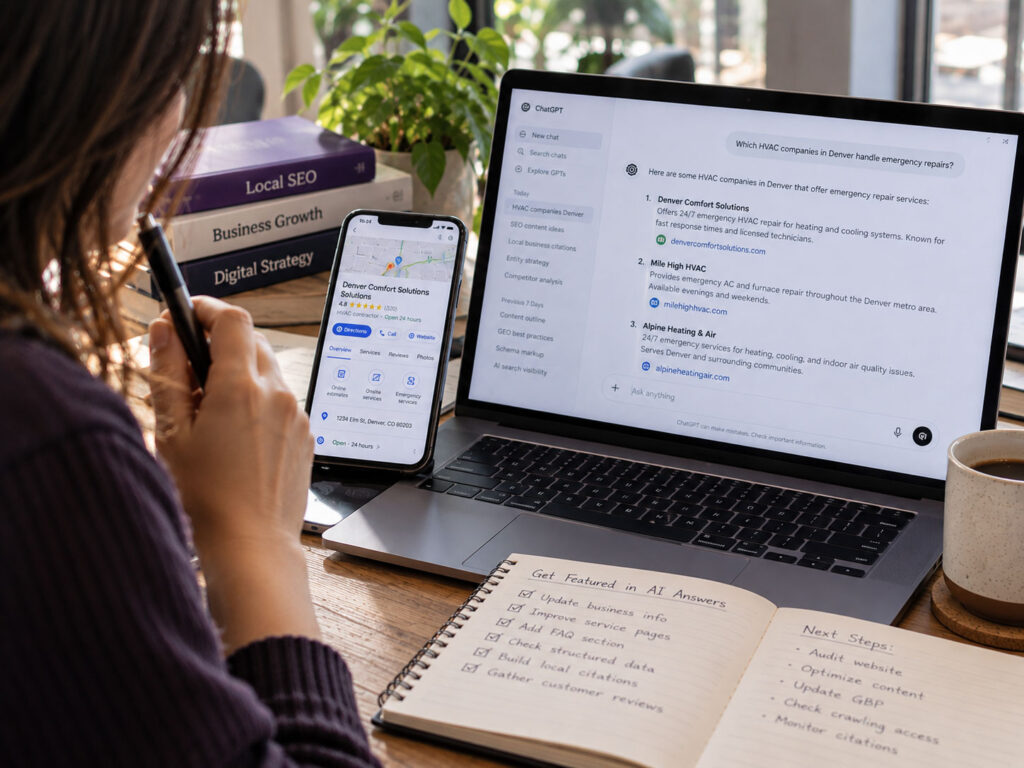
A customer asks ChatGPT which local HVAC company handles emergency repairs. Or they ask Google’s AI Overview to compare two contractors nearby.
If a business isn’t represented in that answer, it misses a real discovery opportunity at the exact moment someone is deciding who to call.
What “Getting Cited” Actually Means
An AI citation is a link or source attribution that points a user to the information behind an AI-generated answer. A business can also be mentioned by name without receiving a direct citation, so AI visibility and AI citation aren’t quite the same thing.
None of the major platforms publish a full formula for why one page gets selected over another.
What they do publish is a set of documented, platform-specific signals, and that’s the distinction worth planning around: what a platform confirms outright versus what practitioners are inferring from observed results.
What the Major Platforms Document
Each platform sources answers differently, but the documented guidance points toward the same underlying priorities: accessibility, accuracy, and clarity.
| Platform | What it documents | What it explicitly recommends |
| Google AI Overviews / AI Mode | Rooted in core Search ranking and quality systems; no special AI markup required | Foundational SEO, unique and valuable content, crawlable and indexable pages |
| ChatGPT Search | Ranks results using multiple factors; placement is not guaranteed | Allow OAI-SearchBot to crawl the site and confirm hosting or CDN settings permit its published crawler traffic |
| Perplexity | Searches the live web in real time and cites original sources | Accessible, well-supported information, particularly for topics that change over time |
| Gemini | Can surface sources and related links for some responses; Google states it can also misrepresent how it performs functions such as citing sources | Treat Gemini’s citation behavior as unverified until confirmed against the underlying source |
Two details worth calling out beyond the table. Google states plainly that no special technical requirement or AI-specific markup is needed to appear in AI Overviews, structured data helps it understand a page but doesn’t guarantee a citation on its own.
And Gemini’s own help documentation warns that it can present inaccurate information about how it works, including how it handles citations, which makes it the platform to trust least for self-reported behavior.
Make Your Website Accessible First
Before any AI-specific tactic, confirm that search systems can reach the information worth discovering.
For Google, pages need to be indexed and eligible to appear in Search before they’re eligible for generative AI features, which means ordinary technical SEO: accessible content and no unnecessary crawl barriers.
For ChatGPT search, confirm OAI-SearchBot isn’t blocked in robots.txt, and check any firewall or CDN rules that might be filtering out legitimate crawler traffic without anyone noticing.
Make Your Business Entity Clear
AI systems need usable, consistent information about what a business is, what it offers, and where it operates. State these facts plainly on the site itself rather than leaving them implied.
For a local business, that means a clear business name, service list, service areas, and contact details, kept accurate everywhere they appear.
A current Google Business Profile can support local search visibility by providing consistent business information such as the name, address, phone number, services, and other relevant details customers may use to find and understand the business.
Use Structured Data Correctly
Structured data has a legitimate role here, but it isn’t a shortcut to an AI citation. Organization, LocalBusiness, or Article markup can help when it accurately describes what’s already on the page.
The rule that matters is accuracy: add markup because it reflects real content, not because it contains a keyword worth targeting.
Create Content Worth Citing
Google’s generative AI guidance emphasizes original, people-first content over pages that simply repeat what’s already available elsewhere. It specifically recommends a distinct point of view, organized so a reader can follow it easily.
Answer the customer’s actual question directly, then support it with specifics that show why the answer holds up. Clear headings, short paragraphs, and tables where a comparison genuinely helps all make a page easier to follow, for a person or a model.
Build Evidence Around the Business
A strong business entity is more than a name and an address. It’s a connected set of facts a reader, or a model, can verify: a business connects to its services, its services connect to specific locations, and its claims connect to supporting evidence.
Lean on first-party information where the business is the authority, and support broader claims with credible third-party sources where genuinely relevant, industry organizations or local news coverage rather than manufactured mentions.
Google advises directly against pursuing inauthentic mentions as a ranking tactic.
Strengthen the Surrounding Content
A single article rarely works in isolation. Businesses that have already worked on optimizing for voice search tend to have a head start here, since voice queries and AI answer queries reward the same direct, conversational answer style.
The same discipline behind writing search-optimized content generally carries over, since content structured for a human reader tends to be structured for machine extraction too.
Future supporting content could reasonably cover ChatGPT search visibility, Perplexity search behavior, and AI search monitoring specifically.
The goal isn’t a page for every possible AI query. It’s building pages that serve a real reader need and reinforce a topic a business is genuinely developing authority around.
Track AI Visibility and Accuracy
Manual testing is a reasonable starting point. Run realistic customer questions through the relevant platforms and note whether the business appears, which pages get cited, which competitors show up instead, and whether the cited details are actually correct.
Google now offers generative AI performance reports inside Search Console, showing impressions and pages appearing in AI Overviews and AI Mode alongside other performance dimensions.
Watch for more than mentions: inaccurate services, outdated details, wrong locations, or competitors appearing where the business itself should reasonably show up.
What to Do When AI Gets Your Business Wrong
Start by identifying the specific inaccurate claim, then make the correct information explicit on the relevant first-party page and confirm that page is crawlable and indexable.
From there, check business profiles and third-party references for conflicting information, and pursue a correction where one is realistically possible.
Avoid the instinct to publish new pages purely to manipulate an AI answer. Improving the underlying information, on the site and everywhere it’s echoed, is what makes accurate facts easier to discover and verify going forward.
Frequently Asked Questions
Does getting cited by AI replace traditional SEO?
No, getting cited by AI does not replace traditional SEO, since Google says its generative AI features are rooted in core Search ranking and quality systems. Foundational SEO work still supports both.
Does schema markup guarantee an AI citation?
No, schema markup does not guarantee an AI citation. Structured data helps Google understand a page’s content, but Google is explicit that it doesn’t guarantee a Search feature or citation will follow.
Do backlinks still matter for AI visibility?
Backlinks still matter as part of a site’s broader authority and traditional SEO performance, though no platform publishes a formula tying backlink count directly to AI citation odds. Treat them as one signal among several, not a substitute for accurate, accessible content.
How long does it take to appear in AI-generated answers?
There’s no reliable universal timeframe, since crawling, indexing, retrieval, and platform-specific behavior all affect when or whether a page appears. Consistent accuracy and accessibility over time matter more than any single optimization pass.
Keep the Fundamentals in Place as Platforms Change
The platforms themselves are still changing how they surface answers, and none of them have published a complete formula.
What each one has confirmed publicly, crawlability, accurate entity information, and content worth citing, is unlikely to stop mattering even as the specifics shift.
Keeping business details accurate, pages accessible, and content genuinely useful is the version of this work that holds up regardless of which platform a customer happens to ask.